
From Wax to Pixels: A Brief History of Jewelry CAD Design
Jewelry CAD Design——Jewelry design has come a long way. In the past, artisans meticulously hand-carved wax models to bring their visions to life, whether crafting intricate 14k or 18k tennis bracelets or designing timeless settings for lab diamonds. Every curve, every prong was sculpted with precision — but also with inevitable human imperfections. Fast forward to today: advanced CAD (Computer-Aided Design) programs like Rhino 3D, MatrixGold, and ZBrush have revolutionized how we create jewelry.
Fast-forward to today, and Rhino 3D, MatrixGold, and Blender have revolutionized the craft—allowing designers to create intricate tennis bracelets, lab diamond rings, and custom 14k/18k gold pieces with pixel-perfect precision.
🔹 Key Evolution Points:
- 1800s: Hand-engraved wax molds dominated high jewelry.
- 1980s: Early CAD software introduced (but limited by computing power).
- 2020s: AI-assisted design, photorealistic renders, and virtual try-on for diamond bracelets.
Let’s take a classic engagement ring with lab diamonds as an example:
🔹 Why CAD Wins for Diamond Ring:
- 0.1mm precision ensures every lab diamond sits perfectly.
- Topology optimization (see GIF below) reduces metal waste in 14k/18k gold.
- Instant modifications—no need to melt down prototypes.
Why Jewelers Are Switching to CAD (Even for Luxury Pieces)
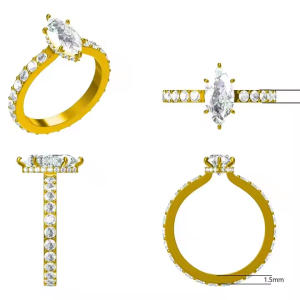
🔹 Jewelry CAD Design——Precision Meets Creativity
- Perfect prong alignment for lab diamonds (no more crooked stones!).
- Virtual stress-testing ensures durability in tennis bracelets.
🔹 Sustainability in Design
- “CAD lets us use 90% recycled gold without compromising detail.” — London-based designer
- 40% less metal waste compared to traditional methods.
🔹Virtual Try-On: The Future of Jewelry Shopping
- Customers can preview 18k gold diamond bracelets in AR before buying.
- Supports skin tone matching: intelligently adjusts metal color (such as warm 14K gold or cool 18K white gold to suit different skin tones)
🔹Personalized customization upfront
- AR gesture editing: Adjust diamond spacing, metal width, and other parameters directly with gestures
- AI style recommendation: Automatically recommend design variations based on the user’s album style (such as pavé or minimalist tennis bracelets)
 London jewelry designer Emma L specializes in custom-made lab diamond engagement rings. She shares, ‘CAD allows us to confidently use 90% recycled metal. We know exactly how much material we need, which is fantastic for both cost and sustainability.’
It’s this approach that has led many modern designs to now incorporate recycled 14K and 18K gold, perfectly blending environmental consciousness with luxury.
How CAD Design Works in Custom Jewelry Creation
🔹Listening to Your Vision
When you approach us with a custom jewelry request, our designers take the time to truly understand your needs, preferences, and ideas for your piece.
🔹Initial Sketch
We begin by creating a rough sketch based on your vision, providing a tangible concept of what your jewelry will look like.
🔹Precision 3D Modeling
Next, we transform the sketch into a highly detailed 3D model using advanced CAD tools. This model ensures that every element, from the setting to the design, is measured with pinpoint accuracy.
🔹Realistic Renders
Through photorealistic rendering, we provide you with a virtual preview of the final piece, showcasing how it will look in the real world—down to the smallest detail.
🔹Customization & Adjustments
You can review the design and suggest any changes you’d like. Whether it’s adjusting the stone setting, tweaking the metal type, or modifying the dimensions, we ensure that the design aligns perfectly with your preferences.
Video- Jewelry CAD design
Here’s a video provides a detailed demonstration of the entire process from CAD design to rapid prototyping, including design, modeling, 3D printing, and final product creation.
FAQs about Jewelry CAD Design

Q: Can I customize my jewelry using CAD if I’m not a designer?
A: Absolutely! Most jewelers will work with you through sketches, inspiration photos, or even simple descriptions to create your perfect piece.
Q: Is CAD only for engagement rings?
A: Not at all! CAD is used for everything from simple 18k tennis bracelets to ornate heirloom necklaces.
Q: How accurate are CAD designs when turned into real jewelry?
A: Extremely accurate — within a 0.1mm tolerance, ensuring a perfect fit and finish.
Q: Does CAD-made jewelry look “machine-made”?
A: Not when done right. The final polish, stone setting, and finishing are still completed by master jewelers, blending digital precision with human artistry.
